History of Plaça de Catalunya

Plaça de Catalunya was open ground outside Barcelona's walls, which came down from 1854. Cerdà's plan of 1859 had no square here, and the city asked for one. King Alfonso XIII inaugurated it on 2 November 1927, during the works for the 1929 Exposition. Later it saw street fighting in the Civil War and the 15-M camp of 2011.

Updated

Key facts

Walls came down
Summer 1854The whole land wall
Cerdà's plan
1859No square here
Inaugurated
2 November 1927By King Alfonso XIII
First metro
30 December 1924Today's L3
Civil War
19 July 1936Fighting on the square
15-M camp
201146 days

Outside the city walls

The square was open ground in front of the gates of the walled city. Barcelona was a military stronghold, so nothing could be built in a wide zone around its walls. The land had been taken from its owners when the fortifications were enlarged, and the State kept it after its military use ended.

Two gates looked onto it: the Portal de l'Àngel, a gate of the walls of the 13th century first called Portal dels Orbs and renamed in the 15th century, on the road to the town of Gràcia, and the Isabel II gate. Poor people from the slums nearby often went to the esplanade in front of the Portal de l'Àngel.

The land wall came down in the summer of 1854, and a wide esplanade was left between La Rambla and Passeig de Gràcia.

How the square was made

  1. 1859

    A plan with no square

    Cerdà's plan for the Eixample, approved on 7 June 1859, had streets and building plots here. The city's own competition, won by Antoni Rovira i Trias, had asked for a large central square outside the Isabel II gate.

  2. 1862

    The city asks for the square to be formed, and gets it onto the official plan.

  3. 2 June 1865

    Cerdà's proposal

    Ildefons Cerdà, by now a city councillor, presents the proposal to make the square and backs the change to his own plan at this spot.

  4. 15 May 1872

    A council decision ends the first attempt to build it.

  5. 29 November 1875

    The Supreme Court confirms that the plots go back to the heirs of Antoni Augirot, against the claims of the State and the city.

  6. 1876 to 1895

    Theatres and cafés

    The open ground fills with places to go out: the Bon Retir theatre, the Circ Eqüestre Alegria, Eldorado Concert and the café La Pajarera.

  7. 1888 to 1889

    Pere Falqués wins the competition held for the Universal Exposition of 1888, and the city gets official permission for the square.

  8. 1892

    The land, and the houses, cafés, theatres and fairground stalls built on it, are expropriated.

  9. 1902

    The first works

    Work begins on two avenues crossing in an X, with a round square where they meet.

  10. 1925 to 1927

    The square of today

    Josep Puig i Cadafalch's project is dropped. The definitive one, by Francesc de Paula Nebot with Enric Catà, Antoni Darder, Félix de Azúa and Pere Domènech i Roura, lays out a large central garden with the traffic round its edge. Joaquim Llansó takes over once the works have begun.

  11. 2 November 1927

    Inaugurated

    King Alfonso XIII inaugurates the square while the works go on.

  12. 1929

    The works end in time for the International Exposition, with the last of the sculptures in place.

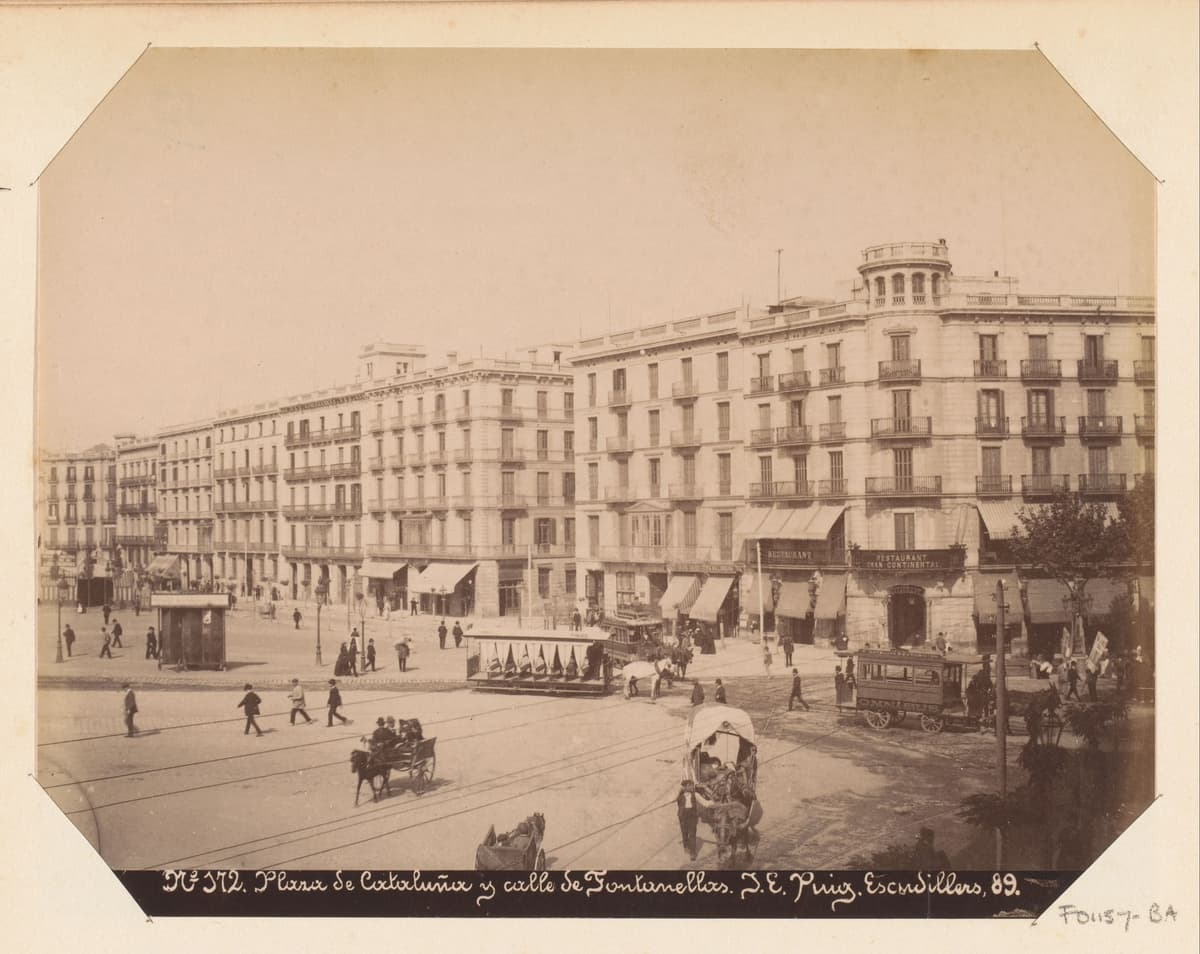
An old photograph of the open esplanade at the head of Carrer de Fontanella, with horse trams and carriages, before the square was laid out
The esplanade at the head of Carrer de Fontanella around 1885, before the square was laid out.

The square since 1929

  1. 1932

    Main-line trains

    The Ferrocarrils del Nord opened their station under the square, the Rodalies station of today.

  2. 1936 to 1937

    The Civil War

    Rebel troops were pinned down on the square on 19 July 1936, and the May Days of 1937 began at the Telefónica building. More in the Civil War on the square.

  3. 1955

    The Banco de España

    The bank opened its building on the square.

  4. 23 September 1959

    The Fonts Bessones

    The two fountains on the upper side were inaugurated.

  5. 1962

    El Corte Inglés

    The department store opened on the east side of the square.

  6. 25 December 1991

    The Macià monument

    Josep Maria Subirachs's monument to Francesc Macià was inaugurated.

  7. 1996 to 1998

    El Triangle

    The shopping centre El Triangle was built, and Café Zurich was rebuilt with it.

  8. 2011

    The 15-M camp

    The 15-M movement camped on the square for 46 days. More in a place to gather.

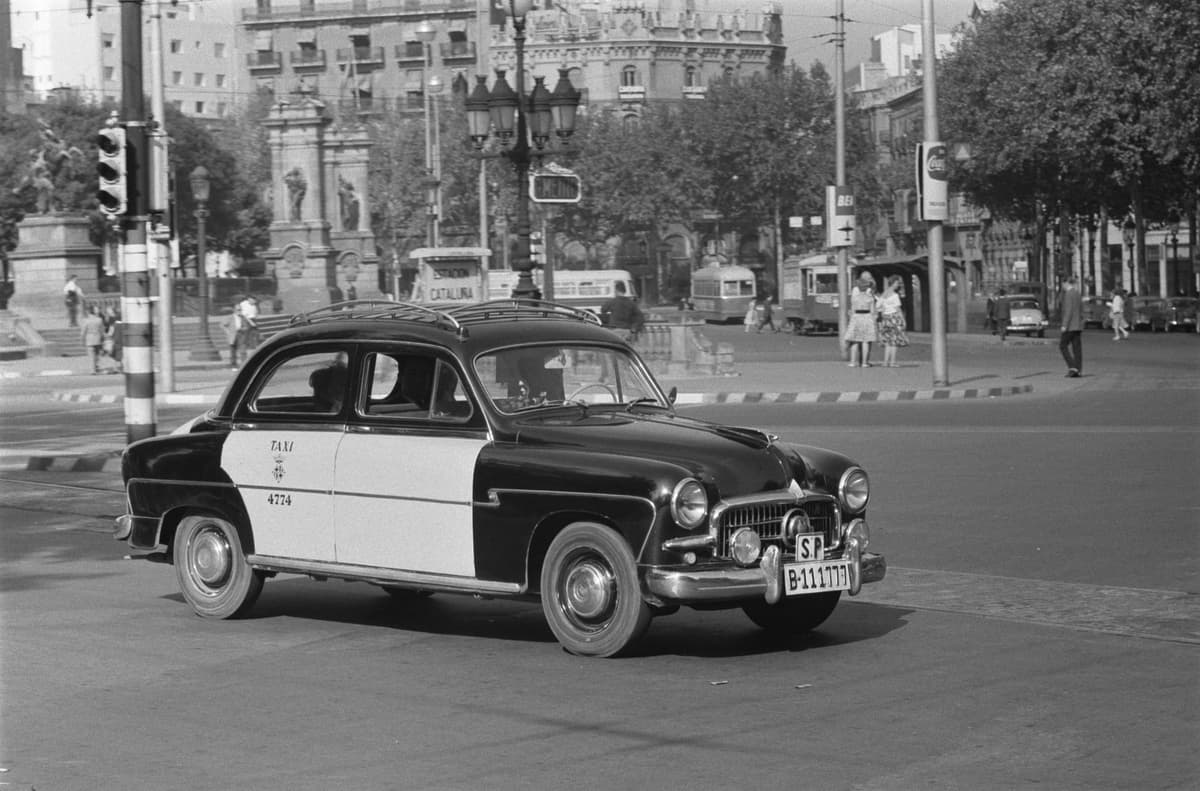
A black-and-white photograph of a two-tone taxi crossing Plaça de Catalunya, with lamp posts, a tram and the statues of the terrace behind
A taxi crosses Plaça de Catalunya in 1960.

The buildings round the square

Until the Civil War, the cafés and restaurants round the square, such as Maison Dorée, Colón, La Lluna and Suís, held many of the city's literary and political gatherings. Almost none survive.

Plaça de Catalunya 10

From the Hotel Colón to the bank

Four buildings have stood on this site: the Gran Cafè Restaurant Colón by Francesc Rogent (1897), the Gran Hotel Colón by Andreu Audet (1902), the Hotel Colón by Enric Sagnier (1916 to 1918), and the Banco Español de Crédito by Eusebi Bona, completed in 1950.

Today the bank building is a hotel.
Plaça de Catalunya 9

Casa Pich i Pon

Josep Puig i Cadafalch built it from 1918 to 1921, crowned by 3 domed temples. The one beside the tower of the new bank came down in the 1940s and was never put back. The other two came down in the early 1960s, and the architect Jordi Romeu restored them in 1982.

On the Portal de l'Àngel corner

The Telefónica building

Ignacio Cárdenas and Francesc de Paula Nebot built it from 1927 to 1928. It was remodelled in 1949. It originally had a green dome, pulled down in 1952. Brian Clarke's stained glass in the lantern tower dates from 1991.

Plaça de Catalunya 17

The Banco de España

The bank opened in Barcelona in 1874 and moved to La Rambla in 1892. Juan de Zavala's building on the square opened in 1955.

Plaça de Catalunya 14

The store opened on the square in 1962 and later took in the shop of Vicenç Ferrer, whose building of 1915 stood at nos. 12 and 13. Its granite façades, by Martínez Lapeña-Torres and MBM Arquitectes, date from 1986 to 1994.

Plaça de Catalunya 1-4

El Triangle and Café Zurich

Cirici & Bassó built El Triangle from 1996 to 1998 in place of the run-down buildings on the west side, known as the illa de la vergonya, the island of shame. Its side on Carrer de Pelai stands over the vaults that cover the FGC station. Federico Correa and Alfonso Milá rebuilt the old Café Zurich inside it from 1998 to 1999.

Plaça de Catalunya 23

The former Banc Central

The building on the La Rambla corner was first the seat of the Banca Arnús. Enric Sagnier remodelled an existing building for it and later joined it with the one on the corner. Its slate domes are octagonal, two small ones and a central one over the rounded corner, which also carries a clock. Today it holds Primark.

The Civil War on the square

On 19 July 1936 the rebel troops planned to march from the barracks on the edge of Barcelona to the centre and take its key points, the Telefónica building among them. Their columns reached Plaça de Catalunya early in the morning and were surrounded and pinned down. Troops under Major López Amor took refuge in the buildings on the upper side, above all the Hotel Colón, until the Guardia Civil took that position.

Workers' organisations then took over the Hotel Colón, and the PSUC set up its headquarters there. The CNT held the Telefónica, and with it the city's communications. On 3 May 1937 the public order commissioner, Rodríguez Salas of the PSUC, tried to take the building. That began the May Days, street fighting that ended on 7 May 1937 with about 500 dead.

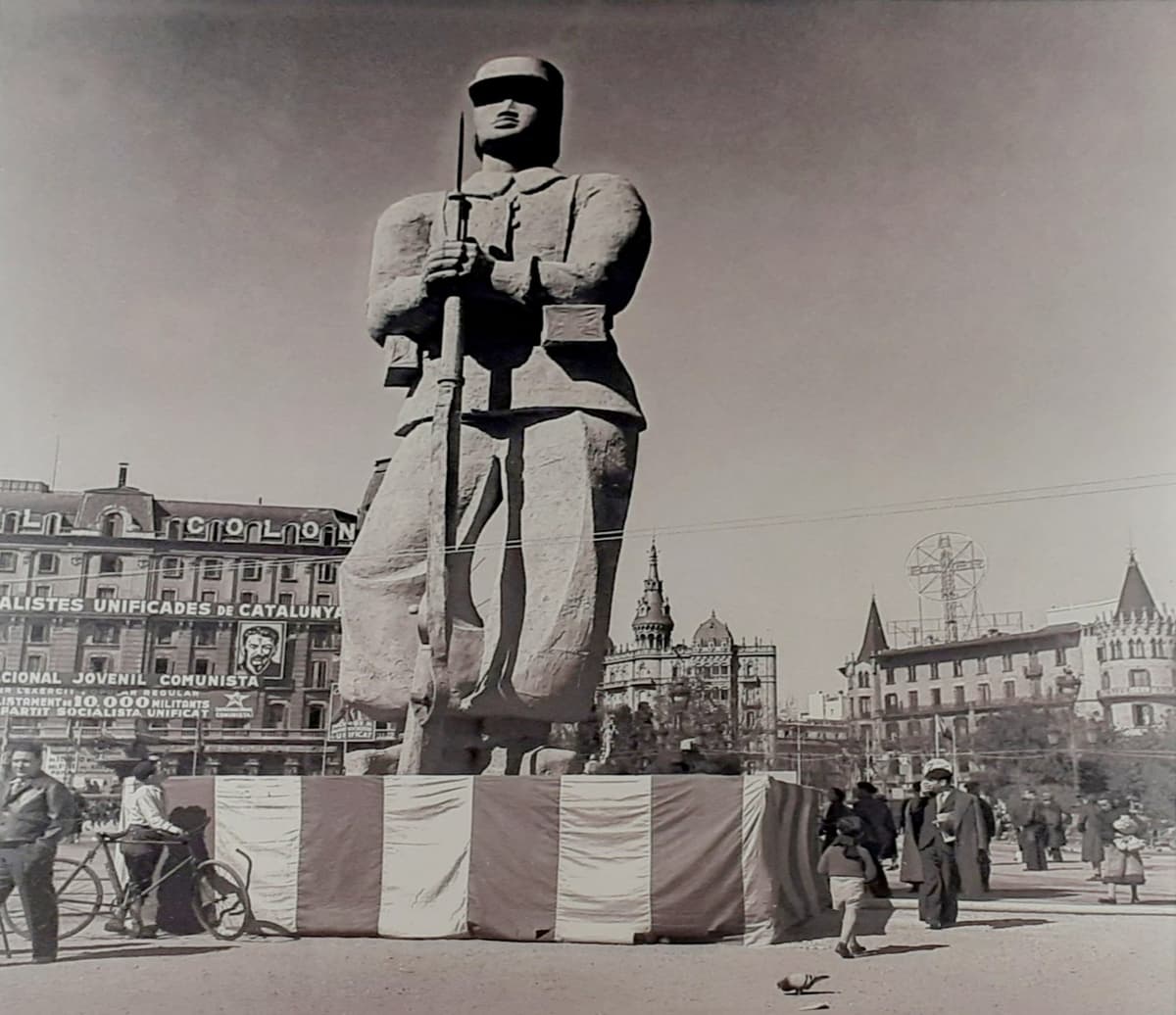
From 14 March 1937 until 1939, a 12 m plaster Monument to the Unknown Soldier by Miquel Paredes stood on the square. An archaeological study has found 167 bullet impacts on the square, 138 of them certain and 29 possible. More than 10 at the base of one sculpture came from the Telefónica.

A giant plaster statue of a militiaman in the middle of Plaça de Catalunya during the Civil War
Miquel Paredes's plaster monument in the middle of the square during the Civil War.

A place to gather

The 15-M movement of 2011 made the square, with the Puerta del Sol in Madrid, the symbol of its revolt. About twenty people began the camp on the night of 16 May 2011. The Mossos d'Esquadra cleared it for a time on 27 May 2011, leaving 121 injured. The Guàrdia Urbana cleared it for good at night on 30 June 2011, 46 days after it began.

Barça fans have gathered at Font de Canaletes, at the top of La Rambla, since the 1930s.

The station under the square

Barcelona's first metro line, the Gran Metro (today's L3), opened between Catalunya and Lesseps on 30 December 1924. The Transversal (today's L1) followed from Bordeta on 10 June 1926, and a corridor joined the two stations in 1956.

The Sarrià railway had run in the open from the square since 1863; it went underground in 1929, and is today's FGC. In 1932 the Ferrocarrils del Nord opened a large station so that passengers from France could change to the Transversal. It was a dead end until a tunnel to Sants opened in 1979.

In the early 1990s the Avinguda de la Llum, the shopping galleries under the square, was given over to the stations and their connections.

Frequently asked questions

When was Plaça de Catalunya built?

The city got permission in 1889 and began the first works in 1902. The square as it is today was laid out for the International Exposition of 1929, and King Alfonso XIII inaugurated it on 2 November 1927.

Who designed Plaça de Catalunya?

Pere Falqués won the competition of 1888. Josep Puig i Cadafalch's project was dropped, and the definitive one of 1925 to 1927 was by Francesc de Paula Nebot with Enric Catà, Antoni Darder, Félix de Azúa and Pere Domènech i Roura. Joaquim Llansó took over once the works had begun.

Was Plaça de Catalunya in Cerdà's plan?

Cerdà's plan, approved in 1859, did not include a square here and instead laid out streets and building plots. The city asked for a square in 1862, and Cerdà himself proposed it as a councillor on 2 June 1865.

What happened at Plaça de Catalunya in the Civil War?

On 19 July 1936 rebel troops were pinned down on the square and held out in the Hotel Colón. The Telefónica building, held by the CNT, was where the May Days of 1937 began.

What was the 15-M camp in Plaça de Catalunya?

It was the 15-M movement's camp on the square, lasting from 16 May 2011 to 30 June 2011. Together with the Puerta del Sol in Madrid, Plaça de Catalunya became the symbol of the movement.