Treball
An equestrian group, the allegory of Work. It faces La Rambla from one side of the pond, with Saviesa on the other.
- Sculptor
- Llucià Oslé
- Year
- 1928
- Material
- Bronze
Plaça de Catalunya has 27 sculptures set up between 1926 and 1929 by 17 sculptors, Josep Clarà and Pau Gargallo among them, plus the Monument to Francesc Macià of 1991. Clarà's marble La Deessa stands in a pond between the two bronze groups facing La Rambla. On the upper side, the Fonts Bessones of 1959 flank 8 statues.
Updated
The sculptures stand round the edge of the esplanade: bronze groups on pedestals with two pillars between each, a figure in a niche on each face of a pillar, and 8 stone statues on the terrace at the top. The numbers run clockwise from La Deessa.
The middle of the square is paved with a star in mosaic, the Rosa dels Vents, part of the square's original design.
La Deessa is Josep Clarà's half-kneeling nude, first called Enigma, from a model of 1911. The white marble on the square is a copy that Ricard Sala made for the city in 1982. Pollution and vandalism had damaged the original of 1928, so the city keeps it in the vestibule of the City Hall.
She stands in the middle of a pond, which protects her, between the bronze groups of Work and Wisdom. The statue was taken away 3 days after it was set up in September 1928, under pressure from moralist groups, and put back before dawn on 19 May 1929, the day before the International Exposition opened.
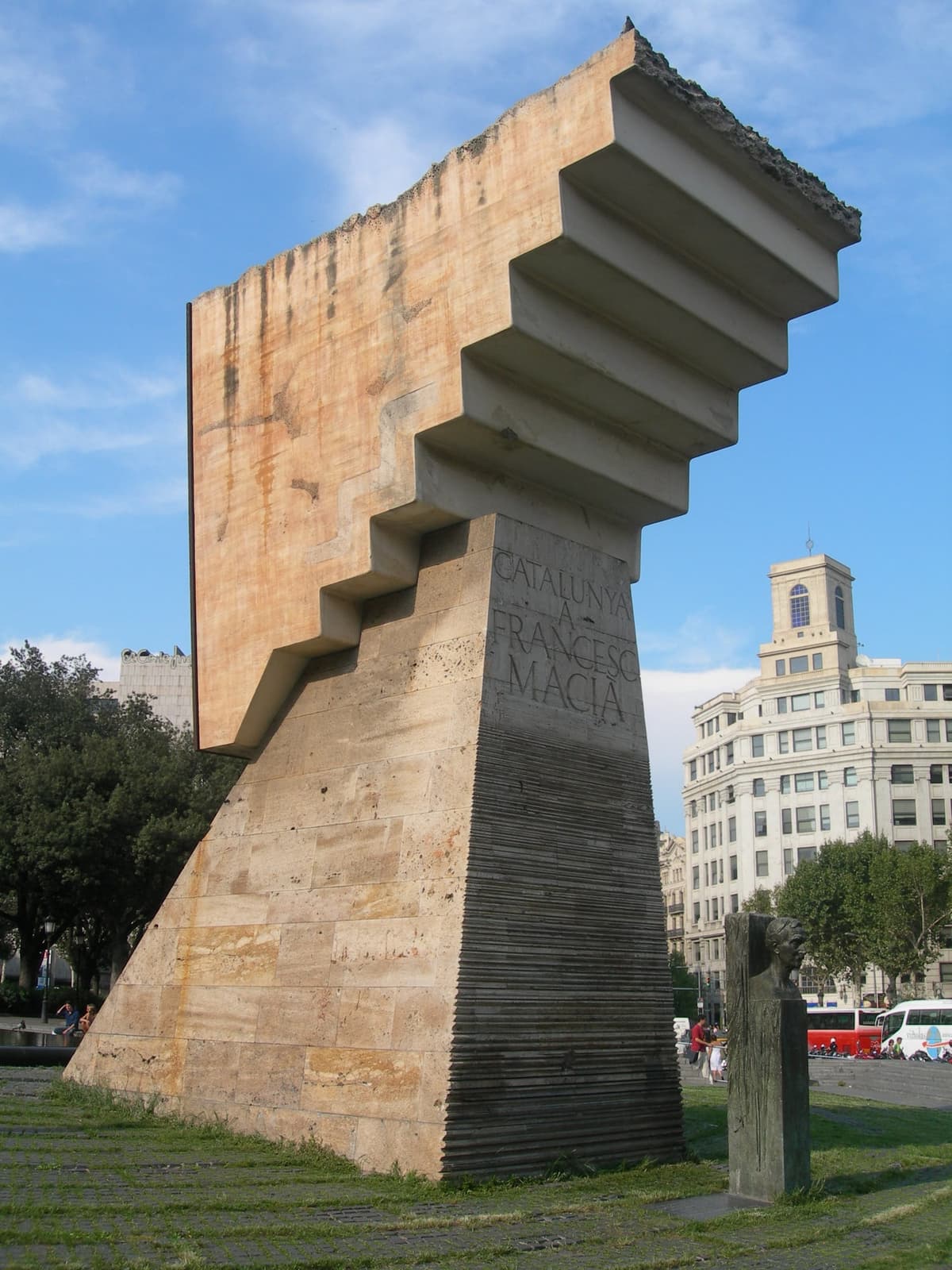
Francesc Macià was president of the Generalitat. He was born in Vilanova i la Geltrú in 1859 and died in Barcelona in 1933. His monument, an inverted staircase in travertine and Corten steel by Josep Maria Subirachs with the architects Helio Piñón and Albert Viaplana, was inaugurated on 25 December 1991, the 58th anniversary of his death.
The lower part stands for the foundations of Catalonia and the upper part for its future. It includes a bronze bust, Josep Maria Subirachs's reading in 1990 of Josep Clarà's portrait of Macià of 1932. The inscription reads Catalunya a Francesc Macià, with his words of 1932 on the Catalonia he had promised the people: politically free, socially just, economically prosperous and spiritually glorious.
It stands at the back of the pond it shares with La Deessa, facing La Rambla. Its contrast with the rest of the square's sculpture drew strong criticism.
Two pillars stand between each pair of groups. Under the niches are the 12 shields of the Catalan capitals by Antoni Agramunt. A pillar's faces are named for where they look: to the sea, down La Rambla, or the mountain, up Passeig de Gràcia; to the Besòs, the east side of the square, or the Llobregat, the west side.
An equestrian group, the allegory of Work. It faces La Rambla from one side of the pond, with Saviesa on the other.
An allegory of Greek and Roman Empúries, with its name carved at its foot. It stands on the sea face of the pillar it shares with Pescador.
A fisherman carrying a basket of fish on his back, on the mountain face of the same pillar.
The only woman among the square's sculptures shown with her face in profile. She stands on the sea face of the pillar she shares with Montseny.
A girl in a shirt and a long skirt, the most modern dress on the square, on the mountain face of the pillar. Nothing in the figure refers to the place it is named after.
A group of an ox with two women on one side, and a woman and a man on the other.
A nude woman on a horse, standing for navigation, and a standing man for industry, with the city's name carved on the base. The group faces Passeig de Gràcia.
Most likely Fra Joan Garí, the legendary penitent of Montserrat, holding an image of the Virgin. It stands on the mountain face of the pillar it shares with Llimona's Figura femenina.
A female figure on the sea face of the Montserrat pillar. Josep Llimona also made El Forjador on the terrace.
Hercules, who founded Barcelona in the legend Verdaguer tells in L'Atlàntida. He stands on the mountain face of the pillar he shares with Dona amb àngel.
A woman with an angel, on the sea face of the Hèrcules pillar.
A group of a man seated on the ground, a girl with a basket and three women, one of them carrying fruit.
A group of three women: one standing, one seated on the ground with two children in her lap, and a third, also standing, with a child asleep at her feet.
A woman holding an image of the Virgin. She stands on the Besòs face of the pillar she shares with L'Esperit popular.
The popular spirit, on the Llobregat face of the pillar, by Jaume Otero, who also made the Tarragona group and the Font dels Sis Putti.
A shepherd defending a lamb from an eagle, one of Pau Gargallo's two shepherds on the square. It stands on the Besòs face of the pillar it shares with Pomona.
A girl with a string of fruit on her back, on the Llobregat face of the same pillar.
An equestrian group, the allegory of Wisdom, with Sabiduría carved on its base. A Roman warrior holds a rearing horse that tramples the snake of ignorance.
The terrace between the Fonts Bessones replaced a small temple first planned there. Four statues face the middle of the square: El Forjador, Dona amb nen i flabiol, Figura femenina and Joventut, from left to right as you look at them. The other four face the other way, towards the mountain.
The blacksmith, a stone replica of the work that won Josep Llimona a prize at the international art exhibition in Brussels in 1914.
A woman with a child and a shepherd's pipe, also known as Maternitat.
A female figure with a small dolphin behind her feet.
This figure represents Youth and is a 1993 copy, as the sandstone original made in Paris had been badly worn by the wind and the fountain beside it.
This allegory of Navigation shows a woman in a Roman cap resting her right arm on a ship's rudder.
A shepherd playing a pipe as he holds a lamb, Pau Gargallo's other shepherd. Like Joventut, it is a copy of 1993 of a sandstone original made in Paris.
A girl, also called Benvinguda or La bona acollida, the welcome.
An allegory of Motherhood, a name also given to Josep Viladomat's Dona amb nen i flabiol on the same terrace.
The Twin Fountains are two lit fountains on either side of the terrace with the statues. Fernando Espiau Seoane, head of the city's water-play and lighting service, designed them, with two high basins that make the slope of the square easier to see. They opened for La Mercè on 23 September 1959.
They are closed for maintenance.
This cascade fountain with bronze putti shows the birth of Venus and stands between the Tarragona and Lleida groups. It faces Portal de l'Àngel with its back to the square, in the middle of a double stair. It was the first thing built when the square was laid out, finished by June 1926, with 4 putti round it and 2 smaller ones under arches.
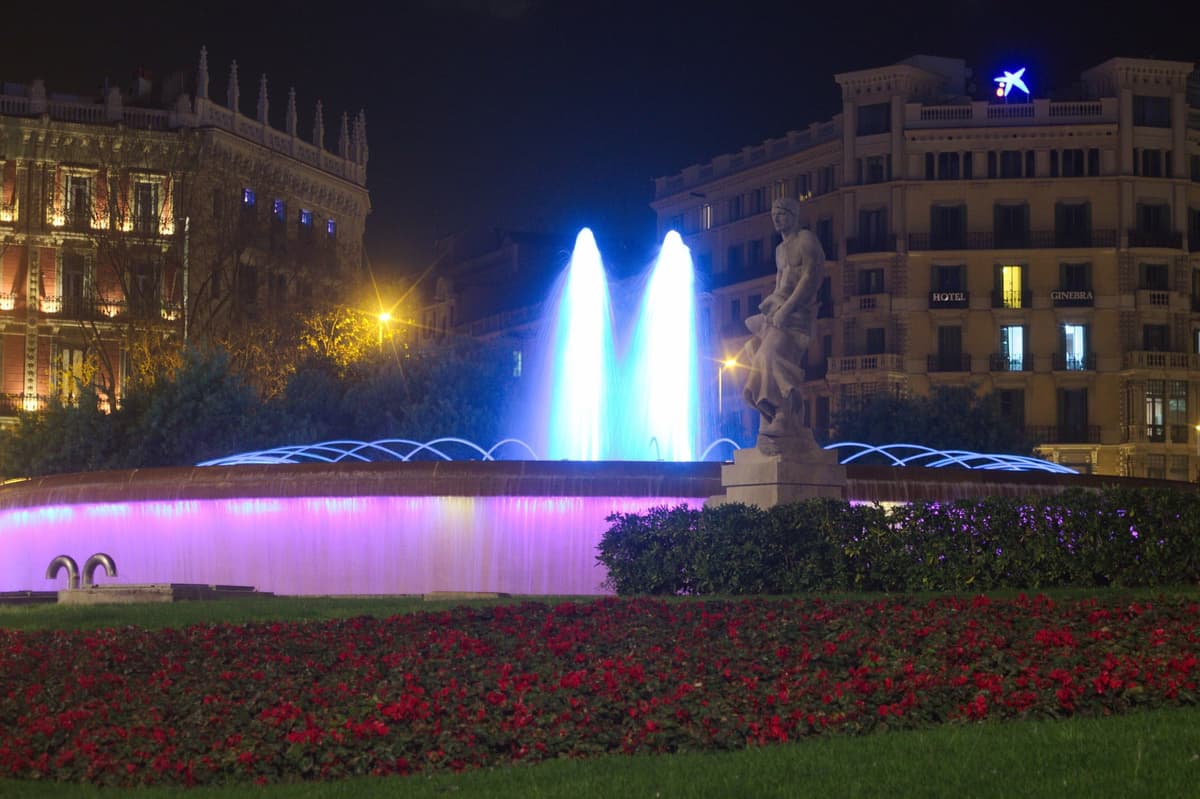
The square has no water-play area for children. Its fountains are ornamental.
Getting into the fountains or bathing in them is banned, and can be fined.
In summer 2026 the city ran 18 water-play areas for children elsewhere in the city, open from June to September, 10:00 to 20:00, 2 of them in Ciutat Vella.
The 27 sculptures set up between 1926 and 1929 are by 17 sculptors, among them Josep Clarà, Pau Gargallo, Josep Llimona, Eusebi Arnau and Frederic Marès. The architect of the ensemble was Francesc de Paula Nebot. The Monument to Francesc Macià is by Josep Maria Subirachs.
The marble statue on the square is not the original, but a 1982 copy by Ricard Sala. The city keeps Josep Clarà's 1928 original in the vestibule of the City Hall.
Plaça de Catalunya has no water-play area, only ornamental fountains, and getting into them or bathing in them is banned. Barcelona's water-play areas for children are elsewhere in the city and open in summer.
The Fonts Bessones, the two lit fountains of 1959 on the upper side, are closed for maintenance.
The lower part of its inverted staircase stands for the foundations of Catalonia and the upper part for its future. It honours Francesc Macià, president of the Generalitat, and was inaugurated on 25 December 1991, the 58th anniversary of his death.
opens in a new tab